Iglesias Professor
"Sometimes our destiny resembles a fruit tree in winter, and who would think, upon seeing its sad appearance, that those rigid branches and thorny twigs will turn green with spring, bloom, and even bear fruit? Yet we expect it, we know it."
Professor
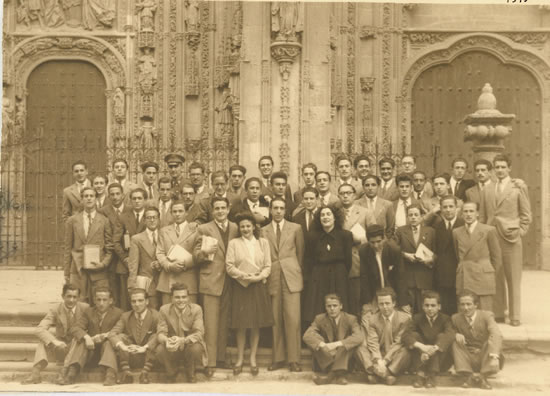
In June 1936, Miguel de Unamuno, Rector of the University of Salamanca, signed the appointment of Juan Iglesias as Assistant Professor of Roman Law. This fulfilled the wish of D. Laureano Sánchez Gallego, professor and deputy in the Cortes, that Iglesias should substitute him in the chair on the occasion of his frequent trips to Madrid. Already by then the young professor—he was eighteen years old—frequented the café gatherings that took place around the Rector. The relationship with D. Miguel, his living teachings, the passionate reading of his works, and the atmosphere of the university city soon left their mark on Iglesias' spirit, who, thirty-five years after Unamuno's death, paid homage to him in the pages of his novel Don Magín, profesor y mártir.
After the interlude of the Spanish Civil War, he remained at the University of Salamanca for one more academic year, then moved to Madrid to join the Faculty of Law where he obtained his doctorate under the direction of his master, Ursicino Álvarez. In 1942, at only twenty-four years old, he obtained the chair of Roman Law at the University of Oviedo. A year later he returned to the University of Salamanca where he remained until 1948, when he moved to hold the chair at the University of Barcelona. In the Catalan city he wrote and published in 1950 his most relevant and widespread legal work: Derecho romano. Instituciones de Derecho privado, a book with which numerous generations of Spanish and Latin American students have been trained and which received the best reviews from Spanish and international Romanistic scholars. After remaining for five years at the University of Barcelona, where he was Vice-Rector, in 1953 he obtained the chair of Roman Law at the Complutense University of Madrid, which he would hold until 1985, the year in which he was given early retirement. During this long period of time (1953-1985) he held the positions of Dean of the Faculty of Law (1956-1957), Director of Colegio Mayor "Diego de Covarrubias" (1956-1958), Secretary General of the National Council of Education (1962-1969), Vice-Rector (1964-1967), and Dean of the Faculty of Information Sciences at the Complutense University (1974-1975).
After his retirement from the Public University, he continued teaching at the Universidad Pontificia de Comillas (ICADE) and at the Colegio Universitario San Pablo-CEU until 1993, when he decided to end his teaching activity after fifty-eight years of exclusive dedication to university life. Away from the chair, his research activity did not cease, extending for ten more years until his death in May 2003.
His passion for the study and teaching of Roman Law was reflected in these words, excerpted from his Visión retrospectiva, published in 2001, which define his conception of teaching:
"I always confessed to them, to my students, as a jurist who does not go in search and pursuit of concepts, but of what is good and just, because that is what Law consists of. I taught them that the true jurist does not commit the sin of disharmony. A sin caused by lack of understanding. I told them a thousand times that for the true jurist, the problem of Law is one single problem: that of the realization of justice. Everything else remains outside the problem."